
Listen to the article summary · 6 min 23 s
AI-generated audio summary of this article
Many adult lives contain the same scene. A relationship is going well and, just as closeness starts to feel real, one person steps back. They need more space, or the diary suddenly fills up. If you have ever recognised yourself in that move, or in someone you cared about, you have probably wondered about avoidant attachment. For a wider picture of how attraction and attachment develop, see the three stages of love.
This is a plain-English guide to understanding it calmly. It explains what avoidant attachment is, how it shows up in a mature relationship, how it interacts with other patterns, and what changes when you are looking for a lasting partnership after 40. It is general information, not a clinical resource: it cannot diagnose you or your partner, and it does not replace the view of a qualified psychologist.
In this article

In brief
Avoidant attachment is a pattern of relating, not a disorder or a character flaw. It describes people who learnt to rely mainly on themselves and who, as intimacy grows, tend to protect themselves through distance, self-reliance or by steering away from emotional conversations. It does not mean a lack of feeling or an inability to love, and it is not fixed: it can soften with experience, with relationships that feel safe and, if someone wishes, with professional support.
What is avoidant attachment?
Attachment theory began in the mid-twentieth century with the work of John Bowlby and Mary Ainsworth on the bond between children and the people who care for them. The core idea is simple: our earliest experiences of closeness and care teach us, without our noticing, how intimate relationships work and how far we can trust someone to respond when we need them.
Decades later, Cindy Hazan and Phillip Shaver proposed that the same patterns can be seen in adult romantic relationships (Hazan and Shaver, 1987, Journal of Personality and Social Psychology). Kim Bartholomew and Leonard Horowitz later described four patterns by combining two questions: how we see ourselves and how we see other people (Bartholomew and Horowitz, 1991, Journal of Personality and Social Psychology). Within that framework, avoidant attachment describes someone who has learnt to lean mainly on themselves and who experiences emotional dependence as a threat to their independence.
In practice, people with an avoidant pattern often value independence, calm and control over their own time. They can be loyal, generous and dependable. The difficulty appears at one specific point: when the relationship asks for more vulnerability, more emotional presence or a more explicit commitment.
One nuance is often lost: avoiding is not the same as not feeling. Someone with this pattern can care deeply and still feel an unease they struggle to explain when another person gets too close. The distance is not a verdict on the partner; it is usually a learnt way of regulating emotional intensity.
A pattern, not a fixed label
Attachment styles are not sealed boxes. They are tendencies that show up more or less strongly depending on the stage of life, the person we are with and what we have been through. Some people behave in an avoidant way in one relationship and much more openly in another.
That is why it is fairer to say “a person with an avoidant attachment pattern” than “an avoidant”. The first describes a way of relating; the second reduces someone to a label. Research on adult attachment also tends to describe it along two dimensions (more or less anxiety about abandonment, more or less avoidance of closeness) rather than in sealed boxes; one reference study that asked precisely whether attachment styles are categories or dimensions is that of Fraley and colleagues, 2015, Journal of Personality and Social Psychology.
Hence a useful distinction: avoiding something is not the same as having an avoidant attachment style. Sidestepping a hard conversation on a given day is human and happens to everyone. We speak of a pattern when the avoidance is stable, appears across different relationships and organises the way intimacy is lived. And emotional maturity is not a matter of belonging to one style or another, but of knowing your own and knowing what to do with it. Attachment theory suggests that attachment can move towards greater security through new relationship experiences, personal reflection and, for those who seek it, professional help. That is a reasonable horizon, not a promise: every story is different and there is no guaranteed timetable.
Where avoidant attachment comes from

Attachment theory holds that the way we bond as adults is shaped, to a good extent, by what we learnt in childhood about how far we can count on other people. When a child grows up with caregivers who meet their practical needs but respond little to their emotional world, or who are uncomfortable with tears or requests for comfort, the child may draw a very reasonable conclusion for their situation: it is safest to ask for little and manage alone. That early self-reliance is not a flaw; it is an adaptation to a particular environment.
It is worth being clear about what this does not mean. Nobody is being blamed: caregivers usually do what they can with the resources and history they have, and it is neither possible nor fair to deduce someone’s childhood from how they relate today. Not everyone with an avoidant pattern had a difficult childhood, and not every difficult childhood leads to this pattern. Every story is different.
Learning does not stop in childhood, either. In adult life, painful experiences can reinforce distance: a separation that left wounds, a relationship in which showing vulnerability proved costly, years of living with tension or with little emotional response. Someone who has been hurt when opening up may conclude that emotional independence is the best protection, and build a life consistent with that idea.
To see the contrast, look at the other end. In secure attachment, asking for help worked, so asking does not set off an alarm. Research on childhood also describes disorganised attachment, which some models relate to the fearful-avoidant pattern we meet below.
What we see in adulthood, namely emotional distance, discomfort with closeness and sometimes a fear of emotional intimacy the person cannot put a name to, is usually the visible part of a very old lesson. The habits that keep needs quiet (changing the subject, staying busy, valuing self-sufficiency above all) can be seen as ways of deactivating the need for closeness. And what was learnt can be revisited: trust that closeness is safe is not decided overnight; it is built through repeated experiences of closeness that go well.
Dismissive or fearful? Four ways of handling closeness
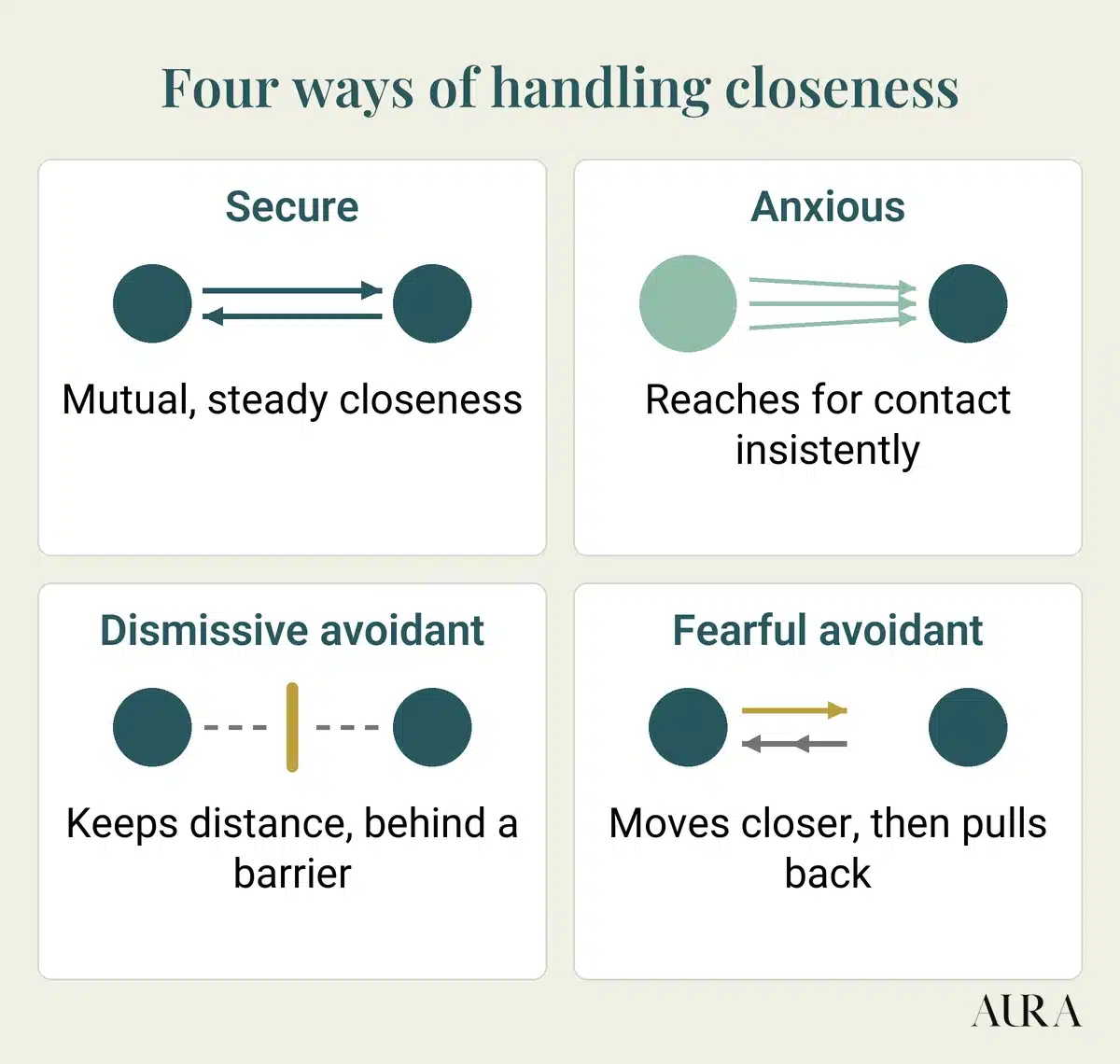
To place the avoidant pattern, it helps to see it next to the other three in the four-category model, and to tell its two forms apart. The illustration shows, very simply, how distance moves between two people in each one: steady mutual closeness in the secure pattern; insistent reaching for contact in the anxious one; distance with a barrier in the dismissive-avoidant one; and advancing and retreating in turn in the fearful-avoidant one.
The difference between dismissive avoidant and fearful avoidant matters because the two are often confused. A dismissive-avoidant person tends to feel comfortable relying on themselves and downplays the importance of closeness. A fearful-avoidant person wants closeness but fears it, and moves between the two.
| Secure | Anxious | Dismissive avoidant | Fearful avoidant | |
|---|---|---|---|---|
| Closeness | Comfortable; asked for and offered without drama | Strongly wanted; fear that the other will drift away | Tolerated up to a point; intense intimacy feels uncomfortable | Wanted and feared at the same time |
| Conflict | Talked through and repaired | Felt as urgent; a need to settle it now | Tends to close the subject or withdraw | Swings between seeking the conversation and fleeing it |
| Independence | Valued without being a defence | Easily given up to avoid losing the bond | Strongly protected; a priority | Alternates between needing it and feeling alone |
| Underlying question | “I can trust and I can be myself” | “Will you still be here if I show you who I am?” | “I am better off if I don’t depend on anyone” | “I want to get close, but I’m afraid of what happens if I do” |
This comparison is a teaching simplification. Nobody fits neatly into one column, and the same person may recognise themselves in several at different times of life.
Has a relationship ever cooled just as closeness was starting to feel real?
Discover how AURA Matchmaking thinks about relationships: with time, discretion and attention to compatibility.
Signs of avoidant attachment in relationships

Describing the signs of avoidant attachment calls for caution: what follows are observable behaviours and possible readings, not a diagnosis. The same behaviour can have many causes, and only the person living it can know what lies behind it.
The signs most often described are marked self-reliance, discomfort with deep emotional conversations, a tendency to create distance as the relationship moves forward, a need for personal space and a habit of closing conflicts quickly, sometimes before the other person feels heard.
| Observable behaviour | Possible reading (a hypothesis, not a diagnosis) | What tends to help |
|---|---|---|
| Changes the subject when the conversation becomes emotional | Emotional intensity feels uncomfortable and is managed with distance | Suggest short conversations at a quiet moment, about one specific thing |
| Withdraws after a moment of real closeness | Recent intimacy creates a need to recover space | See the movement as rhythm, not rejection; agree how to let each other know |
| Prefers to solve problems alone | Has learnt not to depend on others to cope | Offer help without pressing it; show appreciation when support is asked for |
| Closes disagreements quickly (“that’s it, let’s drop it”) | A drawn-out conflict is felt as a threat | Ask for an agreed pause and return to the subject at a set time |
| Is independent in diaries, plans and decisions | Independence is a priority and a form of security | Agree what is shared and what stays separate |
| Finds it hard to say “I need you” or “this matters to me” | Expressing need feels like exposure | Notice concrete gestures of care, even when words are missing |
How it shows up day to day in a mature relationship
After 40, attachment patterns blend with a life that is already built: a career, routines, children or former partners, friendships of many years and a personal way of running a home. For that reason the signs can be less obvious than at twenty. The independence earned over the years is a real value and is not always avoidance.
The difference tends to lie in the reaction when the relationship asks for something more: when it is time to talk about sharing living space, meeting family or saying clearly what each person expects.
Signs that are not avoidant attachment
Before putting a name to what is happening, rule out other explanations. Shyness, an overloaded work life, recent grief, exhaustion, a separation still being absorbed or simply a wish to go slowly can look very much like avoidance.
A useful guide is to look at duration and context. A withdrawal that recurs whenever a relationship gains intimacy, across different relationships and over the years, does deserve calm reflection.
Avoidant attachment in yourself: questions for reflection
Spotting a pattern in someone else is far easier than spotting it in yourself. What follows is not a quiz and has no score: these are open questions to think through calmly. They produce no result, and nobody can reach a diagnosis from them.
- When someone gets emotionally close, what do I feel first: relief, curiosity, unease, a wish to leave?
- What do I do when I am struggling: share it, or wait for it to pass alone?
- Is it easy for me to ask for help? And to accept it when it is offered?
- What happens in me when my partner says they miss me or need more time with me?
- What did I learn, as a child or young adult, about asking, showing emotion or depending on someone?
- What would make me feel secure in a relationship, and what would I be willing to offer in return?
Answering honestly does not oblige you to conclude anything. Building the habits that hold a partnership together, such as listening, handling emotion and asking for what you need, is open to everyone, whatever their pattern. The 10 pillars of a lasting relationship are a good place to begin.
Avoidant and anxious attachment: why they attract and what happens next
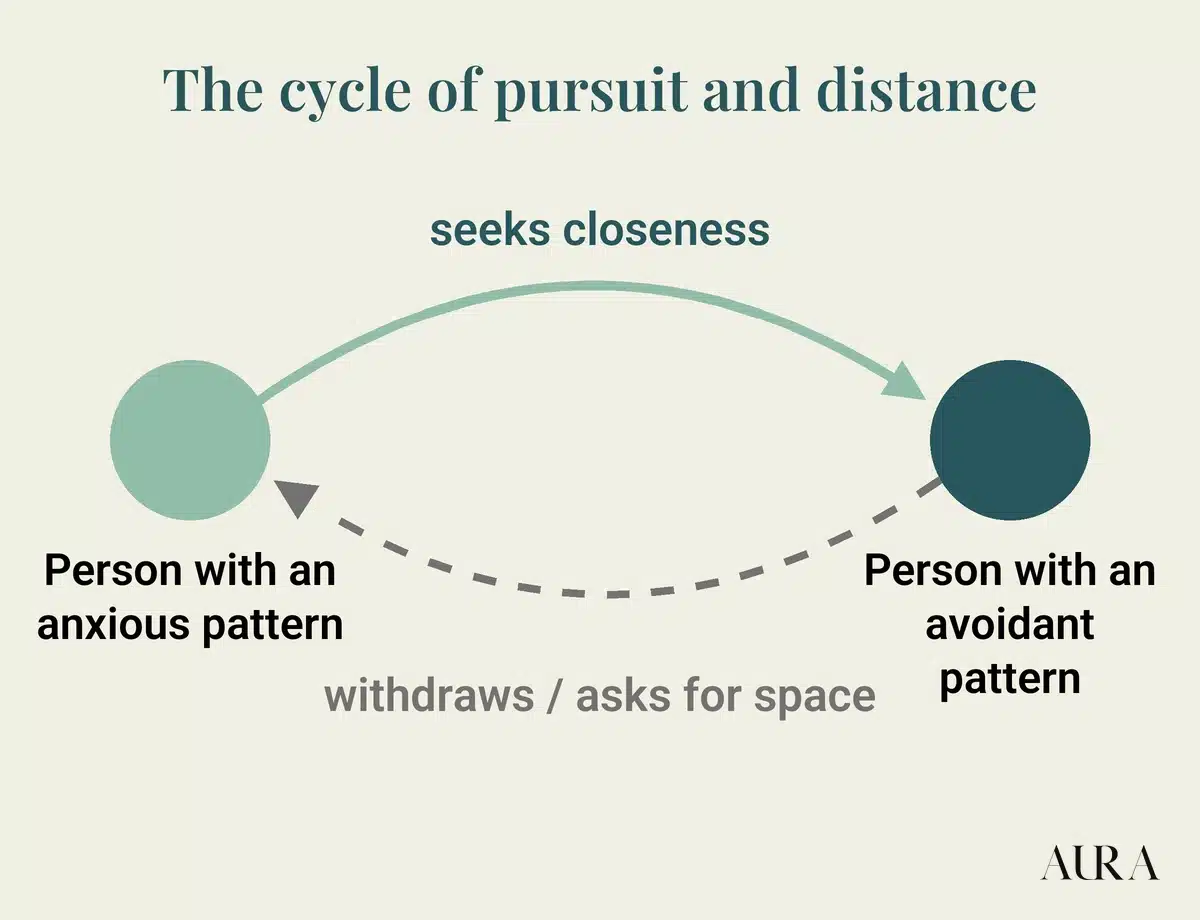
One of the most discussed pairings in popular writing on attachment is the anxious-avoidant one. The early attraction has its own logic: the person with an anxious pattern values the other’s independence and calm, and the person with an avoidant pattern feels appreciated and accompanied without apparent demands. Over time, what attracted can turn into friction.
The cycle is usually described like this. The person who fears losing the bond seeks more contact, more conversation, more reassurance. The person who needs space feels it as pressure and withdraws. The withdrawal feeds the unease of the one seeking closeness, who pursues harder; the pursuit strengthens the need for distance. Neither is acting in bad faith: each is trying to feel safe with the tools they learnt.
| Moment in the cycle | The person seeking closeness | The person seeking space | A communication alternative |
|---|---|---|---|
| Something cools | Sends more messages or asks more questions | Replies less, or more briefly | Name what you notice without blame: “I’ve noticed we’re more distant; could we talk about it this week?” |
| Pursuit | Asks for an immediate explanation | Feels pressured and withdraws | Agree a time to talk instead of demanding it in the heat of the moment |
| Distance sets in | Reads silence as abandonment | Reads insistence as intrusion | Ask for what you need in concrete terms (“It helps me to know we’ll meet on Thursday”) |
| Reunion | Relief and a wish to talk about everything | Relief and a wish not to stir anything up | Take one small topic at a time and end the conversation on something pleasant |
For a broader view of how love develops, the three stages of love offer a useful frame for why desire, romantic love and mature love do not move at the same pace in everyone.
A common question is whether someone can be anxious and avoidant at once. The answer lies in the fourth pattern of the model, fearful avoidant. Here the person wants closeness and fears it at the same time: they approach and withdraw as if two inner voices were speaking.
More stable combinations
Popular writing on attachment often suggests that when one of the two people has a more secure pattern, the relationship can offer a climate in which the other can open up at their own pace. We state this with caution: no combination is doomed and none is guaranteed. What usually makes the difference is both people’s willingness to talk about what is happening, to agree rhythms and not to turn differences into reproaches.
Have you been in a relationship where, just as things were going well, one of you needed more space than the other could give?
Behind AURA Matchmaking is a team that supports people with respect and confidentiality. Meet the people behind it.
What it means if you want a lasting partnership after 40
Looking for a lasting partnership after 40 is not the same as doing so at twenty-five. You arrive with more experience, with earlier relationships that left lessons (and sometimes scars), with a life already organised and a clearer idea of what you will and will not accept. That maturity is an advantage, and it is also where attachment becomes visible.
Someone who has been through a separation or divorce may have reinforced self-reliance as protection: “I will never depend on anyone again”. In both cases, attachment influences what you look for, what you tolerate and how you experience intimacy. If you are at that point, what science says about attraction can help you tell first impressions from lasting compatibility.
What to notice when you are getting to know someone
When you meet someone new, the aim is not to hunt for “red flags” or to assess them like an exam. It is to observe, with curiosity, how closeness is built.
- Signs of gradual openness: the person shares things about themselves bit by bit, responds with interest to what you say, does what they say they will and copes well with conversations about what each of you needs.
- Signs worth discussing calmly: they change the subject whenever feelings come up, disappear after moments of intimacy without explanation, or avoid any conversation about what is expected of the relationship.
None of these signs proves anything on its own. What counts is the whole picture, how it evolves over time and, above all, whether both people can talk about it without drama.
How to build closeness with someone who has an avoidant attachment style
If you live with or are close to someone with this pattern, the useful question is not how to change them but how to create a climate in which getting closer feels safer. A few pointers, without magic formulas:
- Pace. Gradual steps work better than leaps. Moving from dinner to a weekend away and then to living together can be too much without time in between.
- Predictability. Knowing when you will see each other, how you will tell each other about changed plans eases anxiety on both sides.
- Respect for space. Time alone is not a debt owed against the relationship. Agreeing it openly prevents many misreadings.
- Specific conversations. “Can we talk about organising the holiday?” is easier to receive than “we need to talk about us”.
- No pressure. Asking for closeness as an invitation rather than a demand usually gets a better response.
These pointers work in both directions: the person with the avoidant pattern can also try small openings, share one specific feeling, or say that they need a little time before stepping back. To sustain a relationship in the long run, the 10 pillars of a lasting relationship offer complementary ideas.
One necessary warning: this is not a guide to “fixing” anyone. Nobody is responsible for changing another person’s pattern, and any healthy relationship requires both people to feel respected. If you find your own needs are consistently unmet, it is legitimate to raise it and, if necessary, to rethink the relationship.
What if the first meeting came after a conversation about what each person needs from a relationship?
At AURA the process begins with an assessment interview and professional support. See how it works.
When it is worth seeking professional support
Sometimes reading and reflecting are not enough. It may be a good idea to consult a psychologist when the same pattern repeats across several relationships and causes distress, when distance or anxiety interferes with daily life or work, when a recent break-up reopens wounds you do not know how to handle, or simply when you want to understand yourself better with someone alongside you.
A professional can help you explore your history, put words to what you feel and decide with you what work makes sense. It is not about “being unwell”: it is a way of caring for the relationship you have with yourself and with others.
Can you overcome avoidant attachment? Steps for reflection and professional support
People who ask how to overcome avoidant attachment often expect a list of exercises. The honest answer is that there is no universal formula, and that “overcoming” is not the same as “ceasing to be who you are”. What you can do is:
- Observe your reactions to closeness with curiosity, without judging them.
- Identify which situations trigger your need for distance.
- Practise small openings, at your own pace, with people you trust.
- Talk about it with your partner or someone close, if that feels possible.
- Consult a professional if the pattern holds you back.
Compatibility in choosing a partner: the AURA approach
When we talk about attachment, we are really talking about compatibility: how two people fit together with their histories, rhythms and ways of loving. It has to do with values, expectations and the way each person experiences closeness and independence.
At AURA Matchmaking we work on compatibility between people through an assessment interview and professional support throughout the process. Since 2018 we have supported the formation of more than 250 couples. That is not a promise of results, but the experience of a team dedicated to this work.
If you would like to know more, you can read about how AURA Matchmaking works, see why AURA is different or look at membership at AURA.
Visual summary. Tap the image or open it at full size to read it comfortably on your phone.
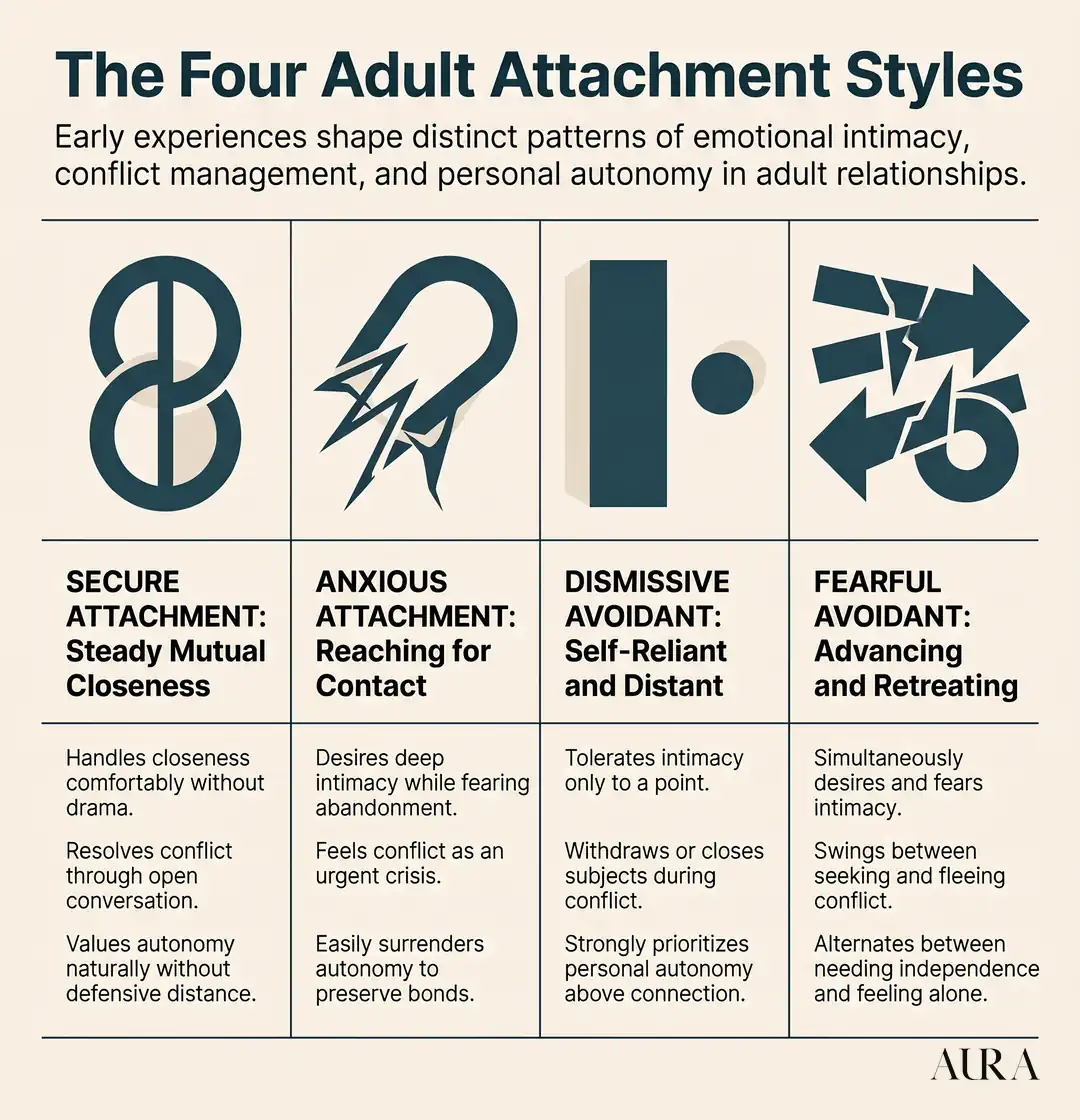
AI-generated infographic based on this article
What would it feel like to meet someone whose way of building closeness matches yours?
If you would like to meet someone with whom to build a lasting relationship, find out how the process works for candidates, with no commitment.
Frequently asked questions about avoidant attachment
It is a pattern of relating, described by attachment theory, in which a person relies mainly on themselves and tends to protect themselves with distance as intimacy grows. It is not a disorder and it does not mean they feel no affection. It is a learnt way of regulating closeness that can soften over time and with experiences that offer security.
A fearful-avoidant person wants closeness and fears it, so the most helpful things are usually consistency, patience and clear, calm communication. Avoid reading each step back as rejection, and avoid pressing for answers in the heat of the moment. If the pattern is causing distress, professional support can help both of you.
Yes. Avoidance is about how closeness is managed, not about how much someone feels. Some people with this pattern love with real commitment and show it through actions, such as reliability, practical care and loyalty, even if saying it aloud is hard. What differs is the way affection is expressed and the pace at which it feels safe to do so.
There is no single sign, but look at consistent actions more than words: they make time for you, keep their promises, remember what matters to you, return after stepping back and show interest in your life. Some people with this pattern express care through deeds. The most reliable approach is to talk about it calmly and see how they respond.
Popular writing on attachment often notes an attraction between avoidant and anxious patterns, because each can seem to offer what the other lacks: calm for one, warmth for the other. This is a tendency, not a rule. People with an avoidant pattern also form stable relationships with partners who offer security and respect their independence.
Go at a gradual pace, be predictable, respect their need for space and raise important topics in concrete, unhurried conversations rather than in the middle of tension. Invite closeness instead of demanding it.
Attachment styles are not fixed labels. They can evolve with new relationship experiences, personal reflection and, if someone wishes, professional support. That does not mean there are timetables or guarantees: the process is gradual and different for each person. Change does not mean ceasing to value independence, but no longer needing it as the only way to feel safe.
When the pattern repeats across relationships and causes distress, when it interferes with daily life, when a recent break-up overwhelms you or when you simply want to understand yourself better with help. A psychologist can accompany you in exploring your history and deciding what work makes sense. Asking for help is not a failure; it is a decision to look after yourself.
To close

Avoidant attachment is not a sentence or a label that explains everything. It is a way of protecting closeness which, once understood, stops being a mystery. If you recognise it in yourself, or in someone you care about, it is worth approaching it with curiosity and patience. And remember: this article is general information, it does not replace consulting a professional and it cannot diagnose anyone. Understanding your own rhythm and someone else’s is, in the end, the first step towards building something lasting in your own way.
